Journal · · 5 min read
How to actually sleep on a long-haul flight
A practical routine for sleeping on an overnight flight: picking a seat, cutting light and noise, keeping your head supported, and timing your rest.
Most of us don't sleep badly on planes because the seat is uncomfortable. We sleep badly because something keeps waking us up: the cabin lights, the drink cart, a crying baby three rows back, or our own head dropping forward the moment we drift off. Fix the wake-ups and the seat matters less.
Before you board
Pick a window seat if you can. You get a wall to lean against and nobody climbing over you at 3 a.m. On most aircraft, seats away from the galleys and lavatories are quieter, because that is where people gather and doors open and close all night.
Dress for a cold cabin. Cabins are often cool on night flights. Wear layers you can sleep in, with nothing tight at the waist, and keep a sweater or a light scarf in your personal item rather than in the overhead bin.
Pack a small sleep kit. An eye mask, earplugs or headphones, a pair of socks, a toothbrush, and a refillable water bottle. Keep it in one pouch so you can grab it without standing up after takeoff.
Cut the light
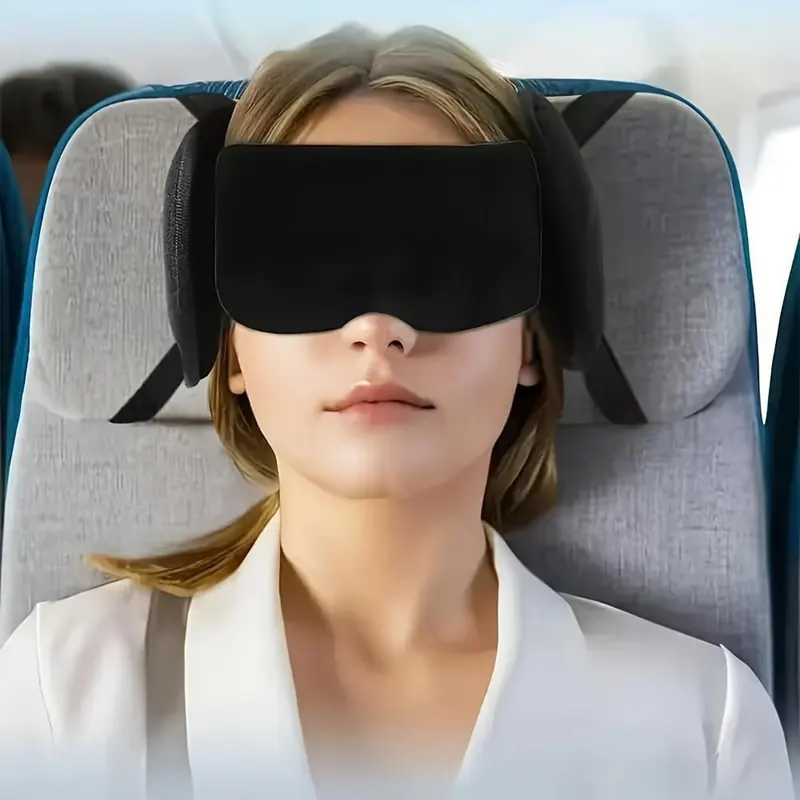
Light is the easiest wake-up to fix. Cabin lights come on for meal service, and seatback screens glow from every direction. A contoured eye mask that doesn't press on your eyelids is far more comfortable for a long stretch than a flat one. Put it on before you need it, so you are not fumbling for it half asleep.
Cut the noise
Engine noise is steady and most people stop noticing it. It's the sudden noises, like announcements, conversations and carts, that wake you. Foam or silicone earplugs are small and cheap; noise-cancelling headphones are great if you can sleep in them, but many people can't lie against a headrest with over-ear cups on.
Keep your head from dropping
This is the one most travelers never solve. Sitting upright, your neck muscles relax as you fall asleep and your head falls forward or sideways. The jolt wakes you, and the cycle repeats all night. A U-shaped neck pillow helps with the sideways lean, but it doesn't stop your head from falling forward.
What does help is anything that keeps your head against the headrest. Some travelers lean against the window with a folded jacket. Others use a head strap that wraps around the headrest and holds the forehead back, often combined with an eye mask. Whatever you use, check the crew's instructions: remove straps during taxi, takeoff and landing, or whenever they ask.
Time your sleep
On an overnight flight east, try to sleep as soon as the meal service ends instead of watching one more film. On a daytime flight, a short nap is usually easier to wake up from than a long one. Either way, set your watch or phone to your destination's time when you board, and plan meals and rest around it.
A simple routine
- Before boarding: water bottle filled, sleep kit in your personal item.
- After takeoff: shoes off, socks on, layers ready.
- After the meal: brush your teeth, then mask, earplugs and head support.
- Seatbelt fastened over your blanket, so the crew doesn't need to wake you to check it.
You won't sleep like you do at home. But a few uninterrupted hours make a real difference to how the first day of your trip feels.
By June Finds. We sell some of the things mentioned here, and we link to them where they fit.